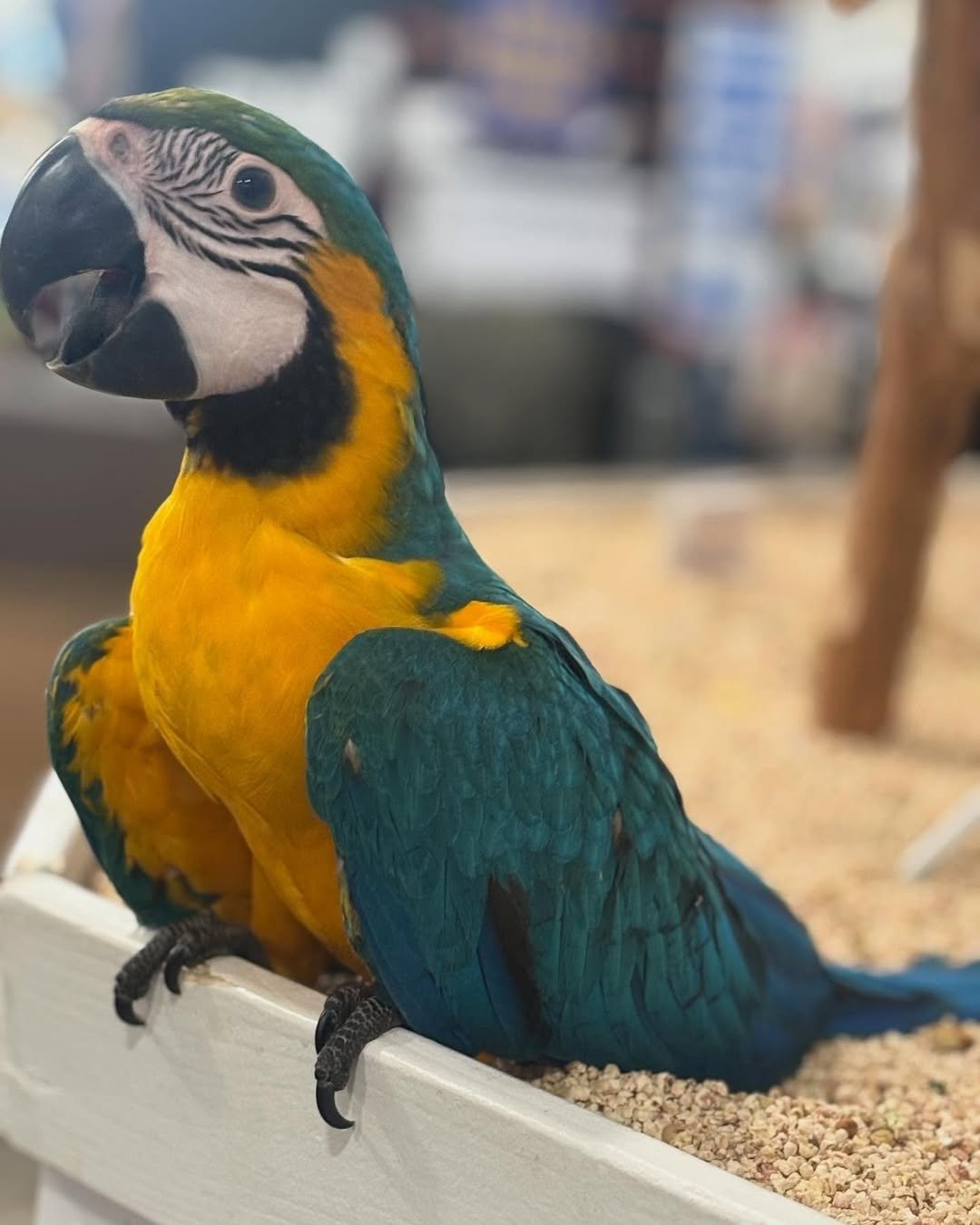
How much space does a macaw need?
When folks visit MACAW PARROTS FOR SALE HOME, they usually have a spot in mind for a cage, but I often have to gently tell them to think bigger—much bigger. To answer how much space does a macaw need?, you have to look at their wingspan; a large Blue and Gold or Hyacinth can have a reach of nearly four feet. At a bare minimum, a macaw needs a cage that is at least 3 feet wide, 2 feet deep, and 5 feet tall, though as a breeder, I consider that more of a “sleeping quarters” than a living space.
Ideally, they need enough room to fully extend their wings and flap without hitting a single bar or toy. Beyond the cage, they require a “bird-proofed” room where they can spend several hours a day out of confinement, along with multiple play stands throughout your home so they can be near the family without being underfoot. If you try to keep a bird this size in a cramped environment, you’re looking at tattered feathers, muscle atrophy, and a very frustrated, loud parrot.
Key Takeaways
- Minimum Cage Size: For large species, nothing smaller than 36″ x 48″ x 60″; smaller mini-macaws can handle slightly less.
- The “Flap” Rule: A bird must be able to fully extend and beat its wings inside the enclosure without touching anything.
- Bar Spacing: Ensure bar spacing is 1 inch to 1.5 inches to prevent head entrapment or easy escapes.
- Vertical vs. Horizontal: Macaws are climbers; they need height but also width to move across perches.
- Outside Area: At MACAW PARROTS FOR SALE HOME, we recommend at least one dedicated T-stand or play gym in a separate room.
How Much Space Does a Macaw Need? Thinking Beyond the Bars
I’ve spent decades watching these birds at MACAW PARROTS FOR SALE HOME, and if there’s one thing I’ve learned, it’s that a macaw views your entire house as their cage. When people ask how much space does a macaw need?, they are often worried about their floor plan. It’s a valid concern. You aren’t just fitting a bird; you’re fitting a small aircraft into your living room.
I remember a client who bought a beautiful Green-wing and tried to keep him in a corner nook. Within a week, the bird had chewed the wallpaper and the crown molding because he could reach them from his perch. Space isn’t just about the cage; it’s about the “clearance” around the bird. You need a “buffer zone.” Macaws are messy eaters—they fling fruit like they’re getting paid for it—so you need enough space around the cage to easily clean the walls and floors. If you’re cramped, you’ll be miserable, and so will the bird.
The Anatomy of a Proper Macaw Enclosure
If we’re getting technical about how much space does a macaw need?, we have to talk about the quality of that space. A huge, empty cage is useless.
- The Footprint: Most commercial macaw cages take up about 10 to 15 square feet of floor space.
- The Tail Factor: Macaws have incredibly long, beautiful tail feathers. If the cage is too shallow, those feathers will rub against the bars every time the bird turns around, leading to “fraying” and a very ragged-looking pet. At MACAW PARROTS FOR SALE HOME, we always suggest a depth of at least 30 inches for this reason.
- Stainless Steel vs. Powder Coated: Because these birds are so strong, the cage needs to be heavy-duty. Thin wire cages will be snapped like toothpicks.
Perhaps you’ve seen those “cockatoo” cages that are tall and skinny? Avoid those for macaws. Macaws need horizontal space. They like to move back and forth between perches. When I’m designing the layout at MACAW PARROTS FOR SALE HOME, I make sure there’s enough room for at least three different levels of perching without the bird feeling crowded.
Living Room Logistics: Play Stands and Foraging Areas
To truly satisfy the question of how much space does a macaw need?, you have to look at your “out-of-cage” setup. A macaw shouldn’t spend more than 10 or 12 hours a day in their cage (including sleep).
I personally use a mix of T-stands and tabletop gyms. If you have the room, a ceiling-mounted “boing” (a large, spiraled cotton rope) is a fantastic space-saver that gives the bird a place to swing and exercise. It’s about creating a “map” of the house where the bird has designated spots. If they don’t have their own spots, they will pick yours—like the top of your expensive armoire or the back of your leather sofa.
At MACAW PARROTS FOR SALE HOME, we tell our owners to think about “vertical real estate.” Use your walls! Installing bird-safe perches on the walls can give a macaw a sense of height and security without taking up precious floor space in a smaller home.
Top Species and Their Specific Space Requirements
Not all macaws are the same size, so the answer to how much space does a macaw need? changes based on the bird you choose.
Space Needs by Species
| Macaw Species | Ideal Cage Width | Wing Span (approx.) |
| Hyacinth Macaw | 48″ – 60″ | 42″ – 48″ |
| Blue and Gold Macaw | 36″ – 48″ | 33″ – 35″ |
| Scarlet Macaw | 36″ – 48″ | 32″ – 34″ |
| Hahn’s Macaw (Mini) | 24″ – 30″ | 10″ – 12″ |
If you live in a smaller home or an apartment, a Hahn’s Macaw or a Noble Macaw is usually the better answer to how much space does a macaw need?. They still need room to fly, but you won’t need to reinforce your floor joists for their cage.
User Guide: Preparing Your Home for a Macaw
Before you bring a bird home from MACAW PARROTS FOR SALE HOME, do a “space audit” with these steps:
- Tape it Out: Use painter’s tape on your floor to mark the dimensions of a 48-inch cage. Walk around it for a day. Can you still get to the kitchen?
- Ceiling Height: Ensure you have enough clearance for a play-top cage. A macaw standing on top of its cage shouldn’t be bumping its head on the ceiling fan (which should never be on, anyway!).
- The “Splatter Zone”: Look at the three-foot radius around where the cage will go. Is there anything there that can’t be hit with a piece of wet mango?
- Flight Path: If you plan on letting the bird fly indoors, clear a “runway” between rooms by removing hanging lights or fragile decor.
Conclusion
So, how much space does a macaw need? As much as you can possibly give them. While they can live in a cage that meets the minimum standards, they truly thrive when they have the freedom to move, flap, and explore. At MACAW PARROTS FOR SALE HOME, we want our birds to be athletes, not ornaments. Providing a spacious, enriched environment is the best way to ensure your macaw stays physically healthy and mentally sharp for the next fifty years. If you’re worried about your layout, give me a call—I’ve helped people fit macaws into everything from suburban mansions to cozy bungalows. It just takes a bit of creative “perch planning.”
Frequently Asked Questions
Can a macaw live in a small apartment?
This is a common follow-up to how much space does a macaw need?. It is possible, but it is very difficult. You will need to be extremely dedicated to “out-of-cage” time and likely choose a smaller species like a Hahn’s. The bigger issue in an apartment isn’t usually the physical space, but the “noise space”—macaws are loud, and walls are thin. If you do keep a large macaw in an apartment, you basically have to turn your entire living room into a bird room to ensure they aren’t cramped.